
Since 2 August 2026 the AI Act requires transparency about AI-generated content. Renders, upscaling and video: what is within the law, the grey area and the questions to ask.
A house with a sea view. A kitchen in late-afternoon light. A flawless garden.
All in a photo that, as it turns out, never existed.
In 2026 the phenomenon already has a name: housefishing. It is the listing that draws viewings with images enhanced (or invented) by artificial intelligence, and that falls apart at the viewing. The Portuguese and European press have already covered it in reports and opinion pieces, among them SAPO's "A casa que não existe" (The house that does not exist).
And since 2 August 2026, the issue is no longer only a matter of ethics and reputation. It now has a European legal framework.
This article explains, without alarmism and without legal jargon, what has changed, what the law says about AI-generated images in real estate, where the grey area lies and what you should ask whoever produces the images of your project.
What changed on 2 August 2026
Regulation (EU) 2024/1689, known as the AI Act, has an article on transparency: Article 50. Its obligations have applied since 2 August 2026.
In simple terms, the article works on two levels:
1. Providers of generative AI systems (the toolmakers) must ensure the generated content is marked in a machine-readable way, so it can be identified as artificial. This is Article 50(2). For systems already on the market before August there is a transition period until 2 December 2026. There is also an exception for assistive editing tools or standard functions that do not substantially alter the content.
2. Professional users of those systems (the deployers) must clearly disclose when they publish content that is a "deep fake". This is Article 50(4).
And this is the point that matters for real estate: the definition of a deep fake is not limited to faces and voices.
AI-generated images in real estate: what the law considers a "deep fake"
Article 3(60) defines a deep fake as AI-generated or manipulated image, audio or video content that resembles existing persons, objects, places, entities or events and that would falsely appear authentic or truthful to the viewer.
Read it again: existing objects, places, events. A house, a street, a view, a beach.
In June and July 2026 the European Commission published the Code of Practice on marking and labelling (10 June; voluntary, with its adequacy confirmed in July) and the final Guidelines on Article 50 (20 July). According to summaries published by law firms that analysed them, several points matter for anyone marketing property:
"Existing" is read broadly. The place does not have to be famous. It is enough that the image looks like a real place.
The test is holistic: what counts is whether a reasonable person would take the image as authentic.
Advertising: the guidelines give a useful example. An AI-generated background in an advert is out of scope. But an AI image that makes the product look better than it really is may be considered a deep fake.
The "creative" exception has been narrowed and is unlikely to cover advertising.
No retroactivity: what counts is the date the content was generated.
Supply chain: the guidelines point to contractual measures that keep marks and labels visible along the chain.
Penalties: fines of up to 15 million euros or 3% of turnover, with lower caps for SMEs.
Note: these points are based on summaries of the guidelines. Before major decisions, check the official text or consult a lawyer.
What about renders? The question nobody is asking out loud
If the law speaks of images "generated or manipulated by AI", where does architectural visualisation stand?
The answer depends on the process, not on the result. Two images that look the same can have completely different status.
Type of image | How it is made | Likely classification | Risk |
Traditional 3D render | Modelling, materials, lighting and rendering in 3D software (Blender, Unreal, V-Ray, Corona…) | Not "AI-generated" content. Outside the scope of Art. 50 | Low |
Text-to-image creation presented as the project | The AI model invents the building, the view, the materials | AI-generated content; if it looks like a real place and could pass as authentic, it comes close to a deep fake | High: label it |
Real photo "dressed" or enhanced by AI (virtual staging, sky, lawn, removing defects) | Photo of an existing property, altered by AI | The typical housefishing case. If it shows something better than what exists, high risk | High: label it |
Render with generative post-production (e.g. a creative upscaler) | Traditional render plus an AI step that rebuilds detail | Grey area: depends on what the AI adds | Medium |
AI-generated video from renders (e.g. first and last frame, or a single image) | The in-between frames are invented by the model | AI-generated content; the AI decides the geometry between the two frames | Medium to high: label and review |
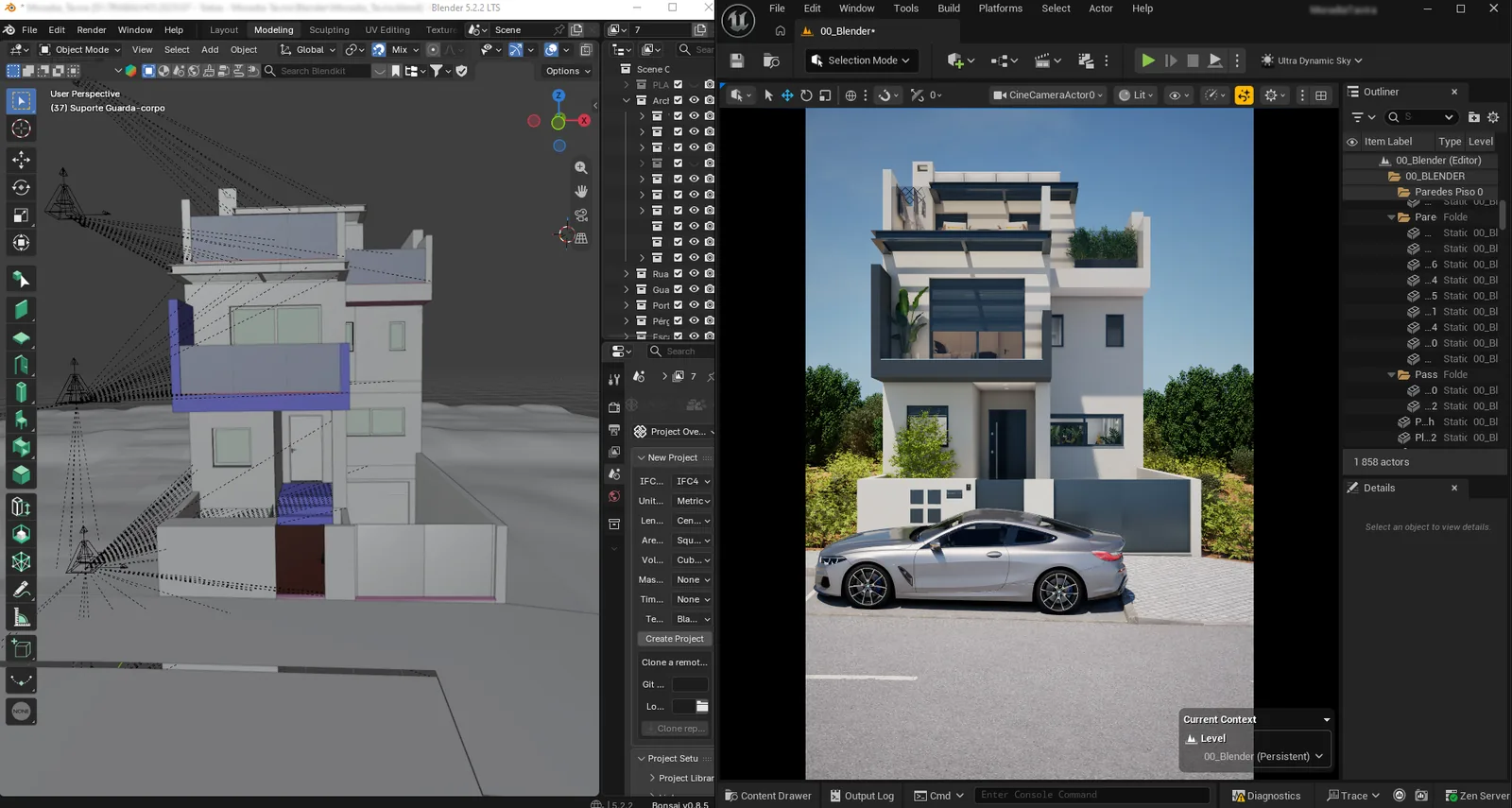
The first row deserves to be said clearly: a render made with 3D modelling and a conventional render engine is not an "AI-generated image". It is a decades-old method of representation. European law does not treat it as one.
The grey area: the upscaler
The fourth row of the table is where the conversation gets interesting, because many studios (including the most rigorous) now use an AI step at the end of the process to increase resolution.
There are two families of upscalers:
Conventional: they enlarge the image by interpolation or by super-resolution algorithms that preserve what is there. They do not "invent" objects.
Generative (diffusion): they enlarge the image and rebuild detail: pores, textures, grain, foliage. At more creative settings they can add elements that were not in the original image.
Tools such as Magnific belong to the second family and let you set the degree of freedom (creativity, fidelity to the original image, HDR, fractality). The more freedom, the more likely the AI is to introduce something the project does not include.
So far I have not found specific Commission guidance on using upscalers on architectural renders. What exists is the principle, and the principle can be applied with a simple test:
Does the final image show anything that does not exist in the project?
If the answer is no, meaning the AI only sharpened what the 3D model already defined, the risk is low and the argument that this is assistive editing is reasonable.
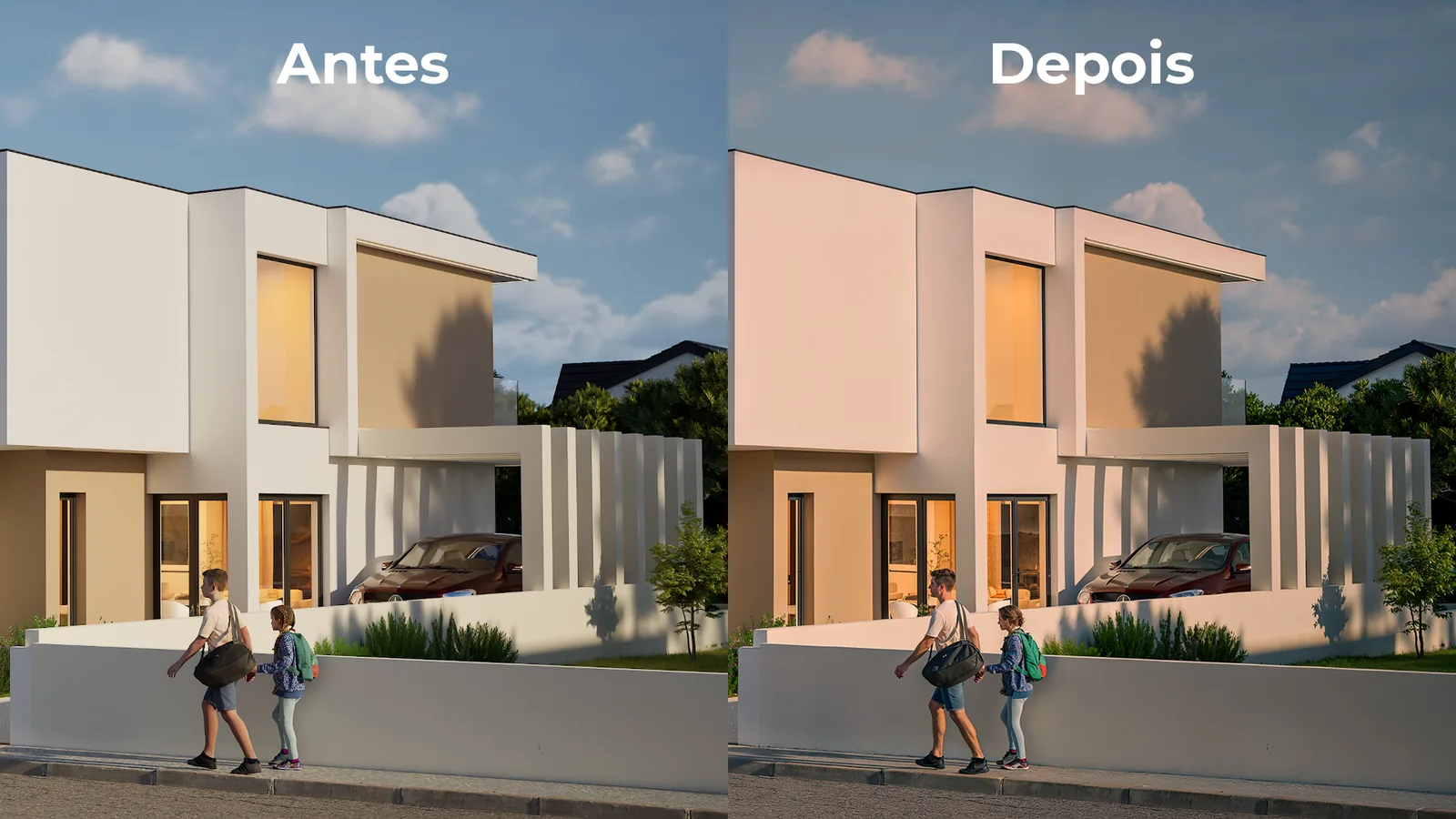
If the answer is yes, because the AI invented a stone texture different from the one specified, added planting, changed reflections or "improved" the street and the neighbours, then the image now shows something that is neither the project nor the real context. And that is exactly the scenario the law and the guidelines want to avoid.
AI-generated video and generic settings: two cases that deserve their own attention
Video from renders
There is an increasingly common way to speed up production: render the first and last frame of a camera move and let an AI model generate everything in between. Or start from a single render and ask the AI to animate it.
This is very different from an upscale. In an upscale, the AI retouches an image that already exists. In the video, the in-between frames are created by the model, which decides on its own the geometry, the perspective and the furniture between the two reference points. It can warp walls, change proportions, duplicate objects or invent elements the project never had.
From the point of view of Article 50, these frames are clearly AI-generated content. Whether they need a visible label depends, as always, on whether the result could pass as authentic and resembles an existing place or object, and for a project not yet built that is not straightforward. To be prudent, the safest practice is to:
Review the clip frame by frame against the 3D model (proportions, materials, furniture, openings);
Reject any video that does not match the real project, however good it looks;
Keep the source frames and the generated file;
Tell the client that the video has AI-generated parts and, if it is used in advertising, add a simple note (for example, "illustrative video, with AI-generated parts");
Not remove metadata or watermarks the tool inserts in the file, because machine-readable marking is the provider's obligation and must not be erased.
Generic settings
Many clients prefer not to show the real surroundings: the street has not been redeveloped yet, there are works next door, or the plot has unphotogenic neighbours. They ask for a generic setting, often enclosed by planting.
Here the problem is rarely AI, even when the setting is created with it, because a generic scene does not resemble an existing place. The risk is different: the buyer may take what they see for the real surroundings. If the location is a selling point and the planting hides neighbours, roads or buildings that exist, this may be misleading under the general rules on advertising and unfair commercial practices, whether or not AI was involved.
The fix is simple and cheap: agree the framing in writing in the brief and label the image as illustrative ("illustrative image, surroundings not representative"). Whoever decides to show a generic setting should be able to show they did it transparently.
And in Portugal? The advertising law was already there
It is worth remembering that the obligation not to mislead was not born with the AI Act.
Property advertising is governed, among others, by Decree-Law no. 68/2004 (advertising of urban residential buildings) and by the general rules on advertising and unfair commercial practices. Information must be truthful and must not mislead the consumer, and this applies whether the image is a photo, a render or an AI creation.
The AI Act adds a layer, transparency about the method, but the underlying principle is the one good property marketing should always have respected: the buyer must not feel deceived at the viewing.
9 questions to ask whoever produces the images of your project
If you are a developer, an agent or an architect, before you approve and publish images it is worth asking:
What was the process? 3D modelling and conventional rendering, an AI-generated image, or a mix?
Was generative AI used at any stage? Upscaling, background generation, added elements, photo editing?
If so, with what settings and what checks afterwards? Was the result compared with the source image? Were the errors corrected?
Do the videos have AI-generated frames? Were they reviewed frame by frame against the project?
Does the image show the real context? Do the street, the neighbours, the view and the planting match reality? If the setting is generic, is it labelled as illustrative?
Are the finishes shown the ones that will be built?
Are the original files and a record of the process kept?
Does the contract say who is responsible for labelling when the images are published?
What happens if an image does not match the real project? Who withdraws or corrects it?
A serious professional answers them all without hesitating. If the answer is evasive, that tells you something.
How I work in my studio
I can only speak for my studio. The process is 3D from start to finish: I model in Blender, furnish and dress the scene, texture it and render in Unreal Engine. Light, materials and composition are decisions made by me and the client, not by an AI model.
At the end I run the images through an AI upscaler with a single aim: to bring out detail, never to change the project. Then I blend the result with the original render and manually remove anything the AI got wrong or deformed. The final image is, in practice, my render with reinforced detail.
When the client does not want the real surroundings and asks for a generic setting enclosed by planting, that setting is a presentation decision agreed with them, and it should be labelled as illustrative.
I have one rule for video: any AI-generated animation made from a render (whether from the first and last frame or from a single image) is only approved if it matches the real project. If it does not, it does not go to the client.
Since August, in line with what the law sets out, I state in the proposal and in the delivery note when there was an AI step, so the client can decide how to communicate when they publish.
A note on accuracy
To avoid confusion, I separate what is certain from what is interpretation:
Confirmed:
Article 50 of the AI Act has applied since 2 August 2026.
The machine-readable marking obligation falls on system providers, with a transition until 2 December 2026 for systems already on the market.
The obligation to disclose deep fakes falls on those who use and publish them.
The Commission published the Code of Practice (10 June 2026) and the Guidelines (20 July 2026).
Interpretation:
That a traditional 3D render falls outside the scope of Art. 50 follows from the fact that it is not AI-generated content.
The classification of generative upscaling depends on the specific case, and I found no specific guidance on it.
Nor did I find specific Commission guidance on architectural video generated from renders. The recommendation to review and label rests on the general principles of Article 50 and on prudence.
Still open:
How national authorities (and the courts) will apply these concepts to real estate.
How responsibility for labelling will be shared between studio, developer and estate agency.
This article is general information and does not constitute legal advice. For specific decisions, especially in large campaigns, consult a lawyer.
Conclusion
AI-generated images in real estate are not the problem in themselves. The problem is the image that promises what the property does not deliver.
The AI Act gave a name and a framework to something the market already felt: a buyer's trust is the most expensive asset to win back. And in a sector where the decision is worth hundreds of thousands of euros, transparency stops being a compliance cost and becomes a selling point.
Those who can explain how their images are made, and show that what you see is what will exist, will have an advantage no filter can give.
👉 Marketing a project and want images that sell without leaving doubts about what is real? Talk to me.
Sources
European Commission, announcement of the Code of Practice on marking and labelling of AI-generated content, 10 June 2026.
European Commission, Guidelines on the transparency obligations of Article 50 of the AI Act, 20 July 2026 (consulted through summaries by Reed Smith, 28 July 2026, and Faegre Drinker, 30 July 2026).
Regulation (EU) 2024/1689 (AI Act), Articles 3(60) and 50.
Euronews, report on housefishing, 25 September 2026.
SAPO, opinion piece "A casa que não existe".
Decree-Law no. 68/2004, advertising of urban residential buildings.
Magnific documentation on upscaler settings (creativity, fidelity, HDR, fractality).
Foreseen Projects (formerly Hugo Guerra Design) is a studio specialising in architectural and real estate 3D visualisation, a strategic partner to architects, developers, builders and interior designers in Portugal.